The Real Difference Is in the Application, Not the Look
Both techniques lighten sections of hair. The difference is how the lightener is applied, and that single variable has significant downstream effects on lift, grow-out, and how the color holds up over time.
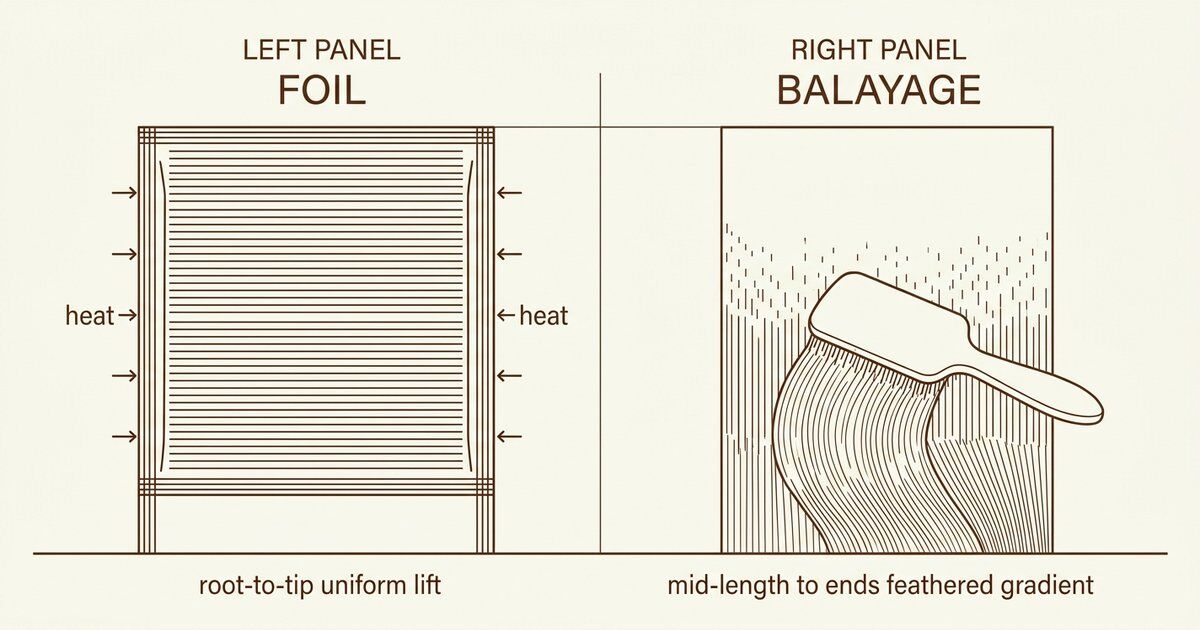
With foil highlights, your colorist weaves out sections of hair, applies lightener root to tip, and wraps each section in a foil. The foil creates a sealed environment that traps heat, which accelerates and amplifies the bleaching reaction. You get strong, consistent lift from root to end. The lightened sections are uniform from the scalp forward, which is what produces that bright, high-contrast finish foil highlights are known for. It also creates a distinct demarcation line where new growth meets lightened hair, which is why foil clients typically need touch-ups every six to eight weeks before regrowth becomes obvious.
Balayage (from the French word meaning "to sweep") uses a freehand painting technique. Your colorist applies lightener directly to the hair with a brush or paddle, concentrating product at the mid-lengths and ends and using lighter, softer strokes near the root. The lightener processes in open air, without foil enclosure. The result is a gentler, more gradual lift that creates soft edges rather than a defined line between lightened and unlightened hair. Because the color starts away from the root, there's no harsh demarcation when new growth comes in. Touch-ups run every twelve to sixteen weeks for most clients.
"Low maintenance" has a specific meaning here: the grow-out is forgiving. It does not mean the result is as bright or dramatic as foil highlights. That distinction matters enormously when clients arrive expecting one and receive the other.
What Your Hair Actually Looks Like at Twelve Weeks
The grow-out behavior of each technique tells the full story.
With foil highlights, the lightened sections start at the scalp. By week five or six, you have a noticeable band of new growth at the root, typically a full shade or more darker than the highlighted length. By week eight, most clients are ready for a touch-up. Push it to twelve weeks and the contrast between new growth and highlighted ends is hard to ignore.
With balayage, the lightened sections begin at mid-length or lower, with the root area left close to your natural color. At twelve weeks, your roots have grown out, but they grow into a tonal gradient rather than a hard line. The overall look softens with time rather than deteriorating into a visible stripe. This is what clients are asking for when they say they want something that grows out gracefully.
The tradeoff is real: balayage typically doesn't produce the same intensity of contrast at the root that foil highlights do. If you want highlights visible from the scalp with strong brightness, balayage won't give you that, no matter how skilled the colorist.
Client Profile Guide: Which Technique Fits Your Hair
Hair color recommendations start with your natural level. The level system (levels 1 through 10, from darkest black to palest blonde) tells a colorist exactly what underlying pigments they're working with and how far the hair needs to lift to reach your target shade. Every level of natural hair contains warm pigments called pheomelanin (reds and yellows) that become exposed as darker pigments are lifted away. That's the chemistry that drives the technique recommendation. The International Journal of Trichology's overview of hair cosmetic chemistry provides a useful foundation for understanding how lightener interacts with melanin during the bleaching process.
Dark base hair (levels 1-4)
If your natural color falls in the darkest range, achieving dramatic lightening through freehand balayage alone is genuinely difficult. The open-air processing of balayage produces a gentler lift than foils, and very dark hair often needs more lift than that gradual process can deliver in a single session. Foil highlights, or foilyage, are the more reliable technical choice for anyone starting dark who wants a noticeable lightened result.
Medium base hair (levels 5-7)
This is where balayage performs most naturally. Medium base colors have enough warm pigment to create beautiful, sun-kissed dimension when lifted, and they don't require the intensive lift of very dark hair. Foil highlights are also effective here. The choice usually comes down to how high-contrast you want the final result. Balayage gives you dimension; foils give you definition.
Fine or fragile hair
Fine hair lifts quickly because there's less structural resistance in the strand, but it also reaches a damage threshold more quickly. The controlled, graduated application of balayage can be gentler on fine hair than a full head of foils, particularly if the hair has any prior processing. That said, a skilled colorist using foils will manage processing time carefully regardless. The technique matters less than the colorist's attention to your hair's condition throughout the service.
Curly or wavy hair
Balayage has a particular affinity for curly and wavy hair because the freehand technique can follow the natural movement of each curl, placing highlights where they'll catch light when the hair falls naturally. If you have texture, ask to see examples of the colorist's work on hair similar to yours before committing to either technique. Our guide to finding the right colorist for your hair type in LA covers texture-specific portfolio evaluation in detail.
Why LA Colorists Think About This Differently
Los Angeles receives over 280 sunny days per year, and UV exposure is not cosmetic background noise for your color. UV radiation attacks artificial pigment molecules continuously. The warm pigments in your hair - the red and orange pheomelanin that any lightening service leaves exposed - are the first to oxidize. Cool toners fade before warm undertones fade. In a sun-heavy climate, color shifts happen on an accelerated timeline compared to what most at-home color advice assumes. The EPA's UV Index Scale puts LA's summer readings in the "Very High" to "Extreme" range for several months each year - a meaningful accelerant on toner fade that foil highlight clients in particular need to account for.
Balayage and lived-in color approaches hold a specific advantage in LA. When balayage fades, the result often still reads as intentional because the technique was designed to look like a natural gradient from the start. Fading doesn't collapse the look; it just softens it further. Foil highlights, by contrast, can read as brassy when the toner wears off and the underlying warm pigment resurfaces, particularly in a climate with this much UV exposure.
LA colorists who work frequently with year-round-sun clients tend to schedule toner refreshes between highlight appointments, specifically to counteract UV-driven tonal shift. If your colorist hasn't mentioned a toning maintenance schedule alongside your highlight service, it's worth asking about it directly. Our article on why highlights turn brassy explains the underlying chemistry and what your colorist should be doing to prevent it.
What Is Foilyage and When Should You Ask for It?
Foilyage is a hybrid technique that combines freehand balayage painting with foil enclosure. Your colorist hand-paints the lightener in the soft, graduated balayage pattern, then wraps the painted section in foil. The foil enclosure generates heat, which amplifies lift, giving each painted section more power than freehand processing alone.
This makes foilyage particularly useful for darker base colors, levels one through five, where freehand balayage can't generate enough lift to make highlights visible. Foilyage takes longer than either technique alone and commands a higher service price. If your colorist recommends it, ask specifically why it's the right choice for your hair and what the result should look like at twelve weeks.
The Maintenance Math
Per-appointment cost is not the right unit for comparing these techniques. Annual cost is.
Foil highlights require touch-ups roughly every six to eight weeks, meaning six to eight appointments per year. Balayage runs every twelve to sixteen weeks, which is three to four appointments annually. Even if balayage costs more per appointment (because the technique takes longer to apply), the fewer visits per year often make the total annual spend comparable or lower.
The more meaningful variable is often not money but time. If getting to a salon every six weeks is difficult given your schedule, that reality should influence your technique choice as much as your aesthetic goal. A foil highlight client who consistently pushes to twelve weeks will have more visible regrowth and a harder correction appointment when they finally come in. A balayage client at twelve weeks is exactly on schedule.
For the studios that consistently handle both techniques well, see the Hair Color LA ranked comparison of top LA studios.