What Actually Happens During a Color Correction Appointment in LA
You've booked the appointment. Or you're thinking about booking it, sitting with a quote that shocked you and a head full of questions about what's actually going to happen once you walk through the door. Color corrections are the most misunderstood service in a salon. Not because they're complicated to explain - but because most of what's written about them either talks around the process or speaks to other colorists, not to the person in the chair.
Here's what actually happens, in order, from the moment you arrive.
What a Color Correction Actually Is (and What It Is Not)
A color correction is not a single product applied to fix a mistake. It's a diagnostic and corrective process that addresses the gap between where your hair currently is - chemically and structurally - and where you want it to be. The gap is what drives the time, the cost, and the session count.
Corrections happen after box dye that's too dark, after a bleach job that went orange, after years of accumulated permanent color that has locked into the hair shaft, or after a salon visit that produced a result far from what was agreed on. What they all share is that the starting point is complicated. Getting to the goal requires precision, not just product.
Standard color appointments work with what's already on your hair. Corrections work against it - lifting out unwanted pigment, neutralizing the wrong tones, and rebuilding the color from scratch. That's a different kind of work, and it takes longer. If you're weighing your options, our ranked comparison of the top LA hair color studios highlights which salons are known for complex correction work.
Before You Book: The Consultation
Any reputable colorist in LA will require a consultation before a correction appointment. This is not a formality. It determines whether the appointment can happen at all, and on what timeline.
At the consultation, the colorist is assessing several things at once. They run their fingers through your hair from root to end, feeling for porosity changes - places where the cuticle is raised versus sealed, because those areas will absorb and release color at different rates. They check your elasticity by stretching a single strand taut and watching how it recovers. Hair that snaps or fails to spring back is not ready for bleach or strong developer; pushing it would cause irreversible breakage. They look at your existing level and tone, evaluating what underlying pigments are sitting in the cortex - because those pigments, especially in dark or box-dyed hair, will surface during the lift process and need to be planned around.
What you need to disclose at consultation, without editing yourself: every chemical service you've had in the past two to three years, including box dye, permanent color, bleach, relaxers, and keratin treatments. Also any scalp sensitivity or medications you're currently taking. Accutane, blood thinners, thyroid medication, and certain antibiotics can change how the scalp reacts to developer and how the hair holds tone - a colorist needs this context before formulating. This isn't about judgment. It's about safety and getting the result right.
Some LA salons offer complimentary consultations. Book one even if you've already done your research. No photo shows a colorist what your actual hair is doing, and a strand test done before your service date means no surprises on the day.
The Appointment Itself: Stage by Stage
Most correction appointments run between 2 and 6 hours, depending on how complex the starting point is. Minor corrections - a toner adjustment, a gloss, a small color re-balance - land at the lower end. Major corrections, like removing years of accumulated black box dye or repairing an over-lightened result, often hit 4 to 6 hours and may require multiple sessions spread over several months.
Here's what happens inside that time.
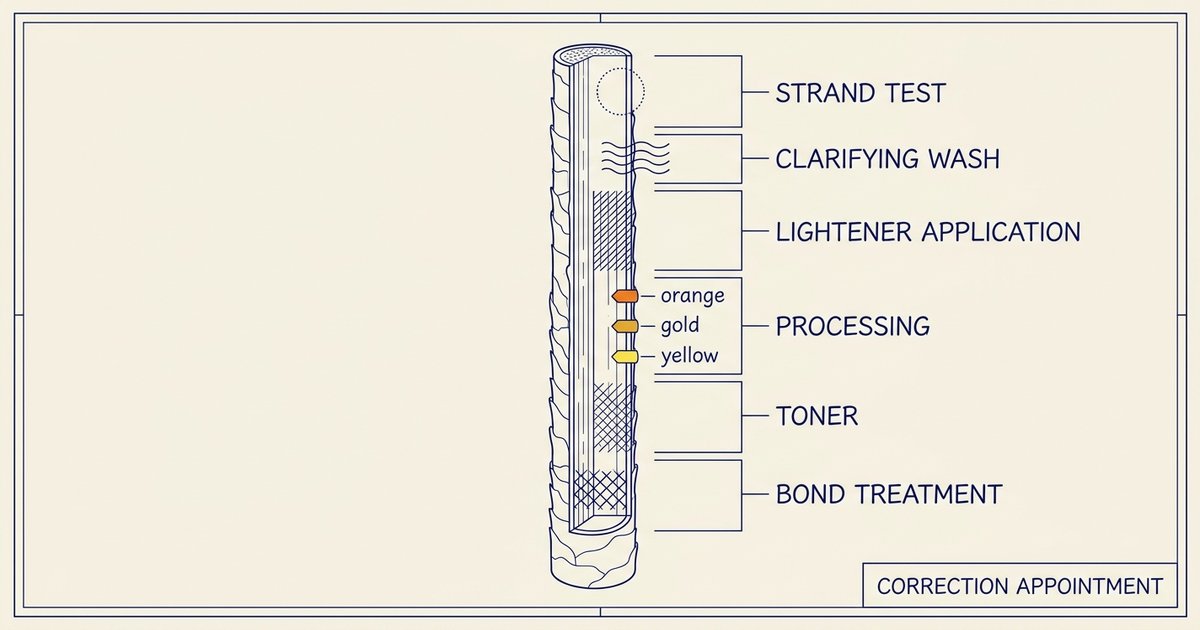
Strand test
Before anything goes on your full head, a properly run correction appointment begins with a strand test on a small, discreet section of hair. The colorist applies the formula they've decided on and watches how the strand responds - how fast it lifts, what underlying tones emerge, whether the hair is holding together or starting to show stress. This test is not offered at every salon, but it should be. If a colorist skips it and tells you they can tell just by looking, that's worth noting. You can also read about the right questions to ask before booking any colorist to ensure this step is part of the plan.
Clarifying wash
Many corrections begin with a clarifying shampoo to strip product buildup - dry shampoo residue, oil treatments, silicone-based products that have coated the shaft and would interfere with how color penetrates. This step is sometimes skipped if the hair is already in a clean state, but for heavily product-coated hair it's necessary before lightener or color can penetrate evenly.
Lightener or color removal application
If you're lifting - going lighter, removing accumulated color, or working with dark box dye - lightener goes on in sections, typically starting away from the roots. The scalp processes faster because body heat accelerates developer activity; the colorist accounts for this by timing the sections differently. The application itself can take 20 to 45 minutes depending on the technique and the length of your hair.
If you're having artificial color removed (a color extractor rather than bleach), the process is chemically different. Products like the Pravana Artificial Color Extractor remove oxidation-type color without bleaching natural pigment - no ammonia, no bleach. This approach works for certain correction scenarios, particularly when the goal is to get back to the natural base rather than go lighter than it.
Processing time
This is the part that takes the longest and feels the least eventful. The lightener or color removal formula is working inside the hair shaft, breaking down the pigment molecules. Your colorist will check the progress every 5 to 15 minutes - this is not a guess or a timer; it's real-time observation. Room temperature, the porosity of your specific hair, the developer volume, and how much product was applied all affect processing speed. No two heads process exactly the same way.
What you'll notice: a chemical smell (that's the developer), possible warmth at the scalp, and if you're lifting, the color shifting through a series of warm tones as the underlying pigment is exposed - orange, then gold, then yellow, in that order. How far through that sequence your hair needs to travel depends on your target shade. Blonde requires taking the hair to a very light yellow, sometimes nearly white, before toning. The EPA's UV Index Scale is a useful reference for understanding why LA-based clients often see their post-correction toner fade faster - UV exposure at "Very High" levels accelerates the tonal shift that the correction worked to achieve.
Rinse and bond treatment
When the colorist decides the processing is complete - based on observation, not just time - the formula is rinsed thoroughly with warm water. At most quality LA salons, a bond-building treatment is applied during or immediately after this step. Bond builders like Olaplex or K18 work inside the hair shaft to reconnect disulfide bonds that bleach and developer break. This isn't optional in a correction context - it's what keeps over-processed hair from becoming over-processed and broken hair during the service. For a full guide to when and why bond builders are worth the upcharge, see our article on whether Olaplex is worth it as a salon treatment.
Toner application
After lifting, the hair is warm. Yellow, golden, maybe brassy orange depending on the starting point and how far the lift took it. The toner is what neutralizes those unwanted undertones and deposits the final color. This step uses a semi-permanent dye, typically mixed with a low-volume developer, and processes for 20 to 35 minutes. The toner is not optional, and it's not just a finishing touch - it's what makes a corrected color actually look like the goal shade rather than a work in progress.
Depending on how your hair took the lift and what result you're after, there may be more than one toning round. A final toner for tone, then a gloss for shine and vibrancy, for example. Each round adds time but also adds depth and accuracy to the result. For a deeper dive into these two services, see our explainer on gloss vs. toner and what LA salons often get wrong.
Conditioning, dry, and style
The appointment finishes with a conditioning treatment - often a mask specific to your hair's condition post-service - followed by a blowout and sometimes a style. The blow-dry is not ceremonial. Heat helps close the cuticle after it's been opened during processing, sealing in the color and temporarily smoothing the shaft. Pay attention to how your hair looks and feels at this stage. A good correction should leave the hair feeling better than it did coming in, not worse.
Why Your Colorist Wants to Split This Into Multiple Sessions
If your colorist quotes you three sessions to get where you want to go, it isn't a sales move. It's a structural limit of how safely the hair can be processed.
Professional lightener can safely lift approximately 2 to 3 levels per session. If you're starting at a Level 3 (very dark brown, accumulated box dye) and want to reach Level 9 or 10 (very light blonde), that's a 6 to 7 level journey. Doing it all in one appointment would require developer volumes and processing times that break down the hair's internal structure past the point of recovery. The result would be hair that snaps, loses elasticity, and cannot hold any color deposited on it.
As the New York colorist Albert Narcisse has noted, attempting to move too far in a single session often produces a result that looks good for two weeks before the instability shows. Staging the correction gives the hair recovery time between sessions - typically 4 to 6 weeks - and lets each appointment build on a more stable foundation. The California Board of Barbering and Cosmetology licenses colorists to perform these services, but correction expertise goes well beyond the licensing baseline - it's worth asking for evidence of specific experience before booking.
For clients working from heavily accumulated black box dye, the full process from start to goal can take 2 to 4 months, sometimes longer. Some corrections take longer; the individual variation is real and honest colorists acknowledge it.
What to Expect Between Sessions
Between correction appointments, your hair will be in a transitional state. It may be lighter than you wanted but not yet at the goal. The toner will fade - expect a 4 to 8 week window for most semi-permanent tones. Color-safe shampoo, specifically a sulfate-free formula, is non-negotiable between correction sessions to slow that fade and protect what's been done. Our article on shampoo ingredients that damage color-treated hair is worth reviewing before you restock your bathroom shelf.
A purple or blue-pigmented shampoo, used once or twice a week, helps counteract the brassiness that creeps back as toner fades. Between sessions is also when a bond-repairing treatment at home makes the most difference - K18 peptide mask or a similar bond-building product helps the hair maintain its structural integrity through the recovery window.
Some fading back toward warmth is normal. Dryness that responds to conditioning is normal. Texture changing slightly as the hair adjusts is normal. Breakage at the roots is not. Hair that won't hold a blow-dry without frizzing out severely is not. Color that washes out completely in the first two washes is not. If any of those happen, call your colorist before your next scheduled appointment - don't wait.
How Much Does a Color Correction Cost in LA?
Color correction pricing in Los Angeles ranges from $200 to $500 or more for standard corrections. Complex cases - multiple sessions, heavily box-dyed or over-processed hair - typically start at $500 with hourly charges of $100 or more beyond that. Established LA studios like The Hive price correction at $125 to $175 per hour depending on stylist tier. Entry-level correction work at budget-oriented shops may start around $100 per hour, but be cautious with pricing that falls well below the market range for complex work.
By comparison, national averages run $150 to $400 per hour for correction services. LA and San Francisco consistently price at the upper end of that range. If you're getting a quote that feels high, the better question is not whether it's too expensive but whether the colorist can explain exactly where each hour is going and what the expected result is at each session. For a full breakdown, see our dedicated piece on color correction pricing in Los Angeles.
Ask specifically: do they charge hourly or by the service? Is there a cap or a flat rate? What does the estimate look like for your specific starting point? You are entitled to a clear answer before you commit. Any colorist who won't discuss pricing in specific terms before the appointment is not protecting you - they're protecting themselves.
Red Flags to Watch For
At the consultation: a colorist who does not check your porosity and elasticity, who skips the chemical history questions, or who promises a dramatic single-session result from a very dark or heavily box-dyed starting point. A brunette-to-blonde result in one session is possible in very limited starting scenarios - but a professional will assess your specific hair before making that claim, not make it as a sales pitch.
During the service: a colorist who is not checking your processing regularly (every 5 to 15 minutes during lift), who seems to be going by a set timer rather than observation, or who cannot explain what they're doing and why at each stage. You should always be able to ask "what are you applying right now and what is it doing?" and get a clear answer.
At checkout: being handed a bill significantly higher than the quoted range with no explanation of what drove the difference. Hour overruns happen in complex corrections, but you should be warned mid-service if the appointment is running long and the cost is increasing.
Questions to Ask Before You Commit
- Can you walk me through what you think will need to happen with my specific hair, step by step?
- How many sessions do you realistically expect this to take, and why?
- Do you charge hourly or by the service, and what's the estimate for my starting point?
- Will you do a strand test before starting the full service?
- What bond-building treatment do you use, and is it included in the service cost?
- What should my hair look like at the end of today's appointment - not the final goal, but what we expect to achieve in this session?
A colorist who can answer all of these clearly and without hedging is worth booking. One who can't - or who promises the final result without discussing the journey - is one you should think twice about. Your money and your hair are both on the line. Make them earn the appointment.