The Real Reason Your Highlights Turn Brassy
You leave the salon with cool, bright highlights. Three weeks later, you're looking at orange. Your colorist handed you a bottle of purple shampoo and told you to use it twice a week. You're doing exactly that, and your hair is still brassy. Something isn't adding up.
The purple shampoo isn't wrong, exactly. But it's a maintenance tool, not a solution. It works on symptoms. Brassiness has root causes, and most of them should have been addressed at the color service itself. This article explains where brassiness actually comes from, what a skilled colorist does to prevent it at the formulation stage, and how to tell whether what you're getting is genuine brassiness prevention or symptom management dressed up as advice.
The Chemistry: Why Warm Tones Are Already in Your Hair
Human hair gets its color from two types of melanin: eumelanin, which produces brown and black tones, and pheomelanin, which produces red and yellow tones. Both exist in your hair at once, but in different ratios depending on your natural color.
When a colorist applies lightener (bleach) to your hair, it doesn't remove all pigment evenly. Eumelanin breaks down first. As it degrades, the pheomelanin underneath becomes increasingly exposed. This is why every lightening service, regardless of technique, goes through a predictable sequence of warm tones on the way to blonde.
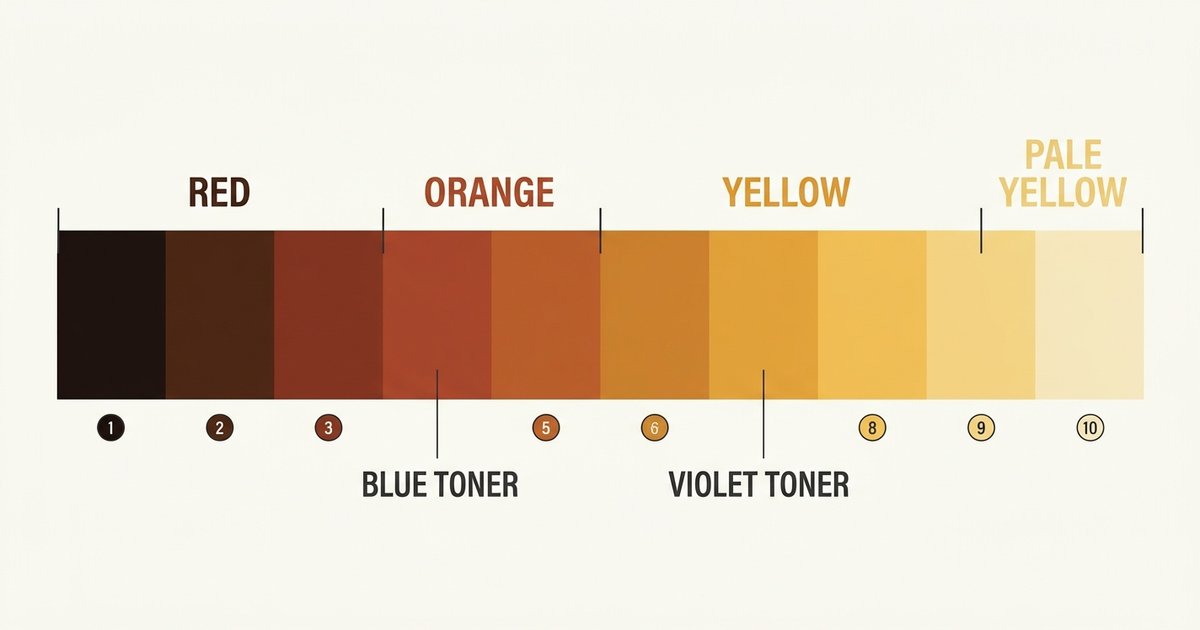
The level system used by professional colorists (levels one through ten, from deepest black to palest blonde) maps this sequence precisely. Hair at levels one through four reveals red when lifted. Levels five and six reveal orange. Levels seven through nine reveal yellow. Level ten reveals pale, almost white-yellow. Brassiness is most intense when hair is lifted into the orange range, roughly levels six to seven, and then left without proper toning to neutralize those warm undertones.
This is not a mysterious process. It is entirely predictable. A colorist who formulates without accounting for underlying pigment is setting you up for brassiness before the service even begins. The International Journal of Trichology's overview of hair cosmetics covers the underlying chemistry of how melanin and artificial pigment interact during color processing - a useful reference for understanding why the level at which you're lifted matters so much for tonal outcomes.
What Your Colorist Should Have Done at the Formulation Stage
The goal is to lift the hair to a level where the underlying warm pigment can be effectively neutralized, then apply a toner that deposits cool or neutral pigment to cancel the warmth out. Color theory is the mechanism: blue neutralizes orange; purple and violet neutralize yellow. Toner is a semi-permanent color product applied after lightening that works by depositing these counterbalancing pigments into the opened hair shaft.
Formulation errors that cause brassiness include:
- Under-lifting: stopping the lightening process before the underlying warm pigment has lifted enough to be neutralized. If your hair is still in the orange zone when the colorist stops processing and applies toner, the toner will not have enough power to neutralize that level of warmth. You'll leave looking cool, but as the toner fades, the orange beneath will resurface quickly.
- Under-toning: applying the toner for too short a time, diluting it too much, or selecting a toner that isn't cool enough to counterbalance the specific warm undertone exposed by the lift.
- No toner applied at all: some colorists skip toning when clients are in a hurry or the salon is rushed. Without a toner after lifting, whatever underlying pigment is exposed is exactly what you walk out with.
- Wrong developer volume: the developer (the activating agent mixed with toner) must open the cuticle slightly to allow toner pigment to deposit. Too low a developer and the toner sits on the surface; too high and it can lift the hair further rather than toning it.
A skilled colorist predicts the underlying pigment they'll hit at a given lift level and selects a toner designed to counterbalance it precisely. "A bit brassy" after a highlight service is not normal. It's a formulation problem.
Why Brassiness Keeps Coming Back
Even a perfectly executed service produces some brassiness over time, because toner fades. Here's what drives that fade:
Toner is a semi-permanent product. It deposits pigment without fully bonding it to the hair structure the way permanent color does. It typically holds for four to eight weeks, depending on the formula, your hair's porosity, how often you wash, and the temperature of your water. As toner fades, the underlying warm pigment it was neutralizing becomes progressively more visible again.
UV oxidation accelerates this significantly. Sunlight breaks down color molecules, and cool, blue, and violet pigment molecules are smaller and more vulnerable than warm pigment molecules. Toner fades before warm undertones fade. In Los Angeles, where the city averages over 280 sunny days per year and summer UV index readings routinely reach 10 or 11 (the "very high" to "extreme" range per the EPA UV Index Scale), this oxidation timeline is compressed. What might take eight weeks in Seattle can happen in four in LA.
Porosity is the other factor. Porosity refers to how open or closed your hair's cuticle is, which determines how readily it absorbs and releases pigment. Highlighted hair has an elevated cuticle from the lightening process. A more open cuticle absorbs toner quickly but releases it just as fast, especially in hard water. High-porosity hair holds color for a shorter window than lower-porosity hair, which means your toner maintenance schedule needs to account for this.
Hard Water and LA Tap: The Factor Nobody Mentions
Los Angeles has documented hard water. The city's tap water runs between 125 and 340 parts per million (PPM) of dissolved minerals, depending on the season and which water source the system is drawing from that year. The Colorado River supply, used more heavily in drought years, can reach the "very hard" classification above 300 PPM. The State Water Project supply is lower. The average across the system sits around 200 to 250 PPM, which falls solidly in the hard range.
Hard water contains calcium, magnesium, and trace metals including copper and iron. When you wash highlighted hair in hard water, the elevated cuticle that came from the lightening process acts as an open door. Mineral ions enter the hair shaft and deposit. Copper deposits in particular can push blonde hair toward green or orange tones. Iron deposits dull brunettes and distort tonal clarity. These mineral deposits also physically lift the cuticle further with each wash, making it easier for toner pigment to escape. The result: color fades faster, brassiness reappears sooner, and you're back in the salon chair for a re-tone before you should be.
The fix for the mineral problem is a chelating shampoo, not a purple shampoo. Chelating agents, such as EDTA or sodium phytate, are compounds that bind to mineral ions and lift them from the hair shaft. Chelating shampoos should be used periodically (not at every wash) to remove mineral buildup before it accumulates to the point where it affects tone. Your colorist can also apply a chelating treatment at the salon as a pre-color step. This is especially relevant in LA, where the water hardness makes mineral buildup a baseline condition rather than an occasional problem. For the full breakdown, see our article on how LA's hard water and sun affect your color.
Purple Shampoo vs. Toner vs. Gloss: What Each Actually Does
These three things are frequently conflated, and they do genuinely different things.
Purple shampoo is a tinted rinse-off product you use at home. It contains violet pigment that temporarily deposits on the hair surface during washing, neutralizing yellow tones through color theory (violet is opposite yellow on the color wheel). It's a home maintenance tool with a short window of effect. It works best on light blonde hair with yellow undertones and is not effective at neutralizing orange or red-range brassiness. If your highlights are in the orange range, purple shampoo won't help you. You need blue shampoo, which targets orange tones, not yellow.
Toner is a professional color product applied at the salon. It uses a low-volume developer (typically 5 to 10 volume) to open the cuticle slightly and deposit neutralizing pigment directly into the hair shaft. It's a corrective treatment, not a maintenance rinse. Results last four to eight weeks depending on the formula and your home care. Toner addresses brassiness at the cause by re-neutralizing whatever warm pigment is now exposed, rather than just coating the surface.
A gloss is typically a gentler, more acidic deposit treatment that adds shine and tonal enhancement without the corrective power of a full toner. Some professional formulas serve both purposes simultaneously. A gloss can be appropriate for refreshing tone between full color appointments when the hair doesn't need aggressive correction but could use a tonal boost. For a complete breakdown of the difference between these two services, see our piece on gloss vs. toner and what LA salons get wrong.
The point is that purple shampoo maintains. Toner corrects. If your colorist's entire brassiness solution is purple shampoo, they're treating a symptom and sending you home to manage it.
How to Tell If Your Colorist Is Treating Root Cause or Just Symptoms
Here are the questions to ask that will tell you quickly what level of formulation thinking is happening at your appointments:
- "What level are you lifting my hair to, and what underlying pigment will that expose?" A colorist who can answer this question specifically understands the level system and is planning the toner before the bleach goes on.
- "What toner are you using and why is it the right one for my underlying pigment?" The formula choice should be deliberate, not default.
- "How long should I expect this tone to hold, given how much sun I'm in?" In LA, the answer should be shorter than the generic four to eight week range.
- "Is there anything about the water at my house that could be affecting how fast my color shifts?" A colorist who factors in hard water into the maintenance conversation is treating the full picture.
- "If I come back brassy in three weeks, is that a formulation issue or a maintenance issue?" The honest answer to this question depends on how the service was performed. A good colorist won't automatically blame the client.
What You Can Do Between Appointments
There are real steps that extend the life of a correctly formulated highlight service:
- Use the right toning shampoo for your undertone. If your brassiness is yellow, purple shampoo is appropriate. If it's orange or red, blue shampoo is the correct choice. Using the wrong one does nothing useful and can leave an uneven deposit.
- Wash with cooler water. Hot water expands the cuticle and accelerates pigment loss. Warm or cool water keeps the cuticle tighter and color molecules inside longer.
- Use a chelating shampoo once a month to clear mineral buildup from LA's hard tap water. Don't use it more frequently than that, as it can be drying and will strip some color along with the minerals.
- Apply UV protection before going outside. UV-protective leave-in sprays and conditioners with UV filters slow down photochemical degradation of your toner. In LA, this is a year-round maintenance step, not an occasional-summer precaution.
- Limit heat styling without protection. High heat can open the cuticle and volatilize color molecules. Heat-protectant products with film-forming polymers help keep the cuticle sealed during styling.
None of these steps will fix a poorly formulated service. But applied consistently to a well-executed one, they can meaningfully extend how long your highlights stay at their best tone. The Hair Color LA ranked comparison of top LA studios highlights which studios are known for the kind of formulation precision that reduces brassiness from the start.