How Hard Water and LA Sun Ruin Your Hair Color
You spent three hundred dollars on a color service. The tone was perfect walking out of the salon. By week two, it's already shifting brassy. By week four, it looks nothing like what you paid for. You're not imagining this, and it's probably not just your shampoo.
If you live in Los Angeles and have color-treated hair, you are managing two simultaneous environmental forces that most color maintenance advice never accounts for: a hard water supply with mineral content that physically damages your color, and a sun exposure profile that accelerates color oxidation faster than almost any other major US city. Understanding what each one actually does, and how they compound each other, changes how you protect your color investment between salon visits.
What "Hard Water" Actually Means for Your Hair
Water hardness is a measure of dissolved mineral content, primarily calcium and magnesium ions, quantified in parts per million (PPM). The EPA's guidance for water quality marks water as hard above 150 PPM and very hard above 300 PPM. The EPA's secondary drinking water standards address the aesthetic effects of minerals like calcium, magnesium, and total dissolved solids on water appearance and palatability - the same minerals that affect color-treated hair.
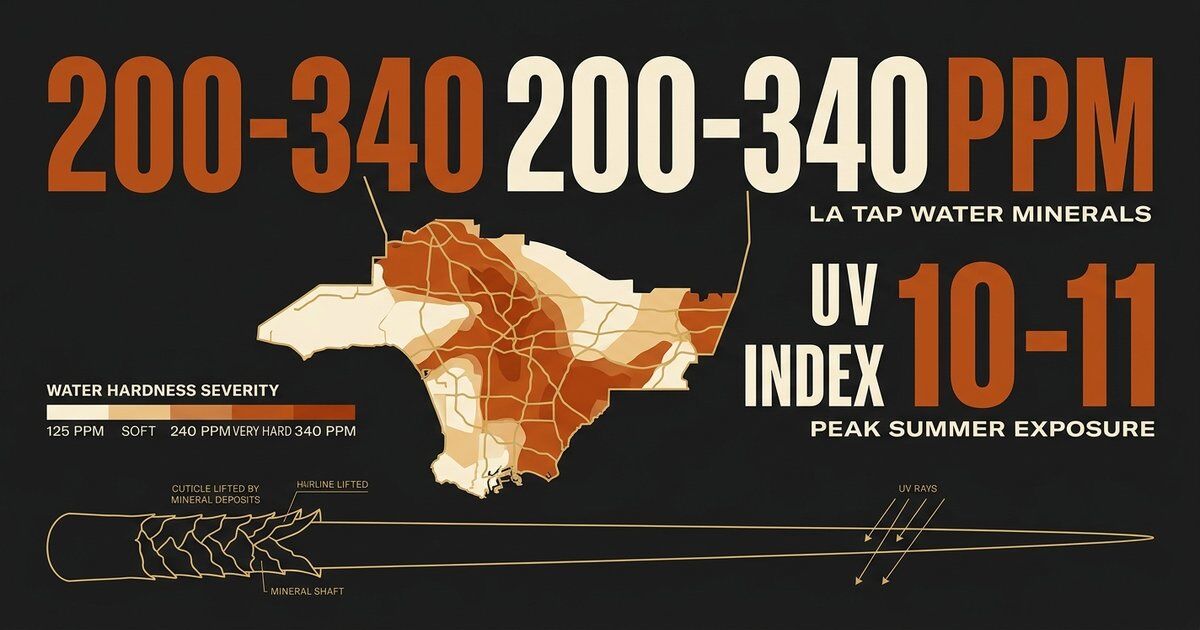
Los Angeles tap water is hard. The city's system averages 200 to 250 PPM, with a range of 125 to 340 PPM depending on the season and which source water is active. The city draws from two primary sources: the Colorado River supply, which runs 280 to 340 PPM (very hard), and the Northern California State Water Project, which comes in at 125 to 160 PPM (hard). In drought years, when Colorado River reliance increases, your tap water gets harder. Wetter years bring more State Water Project supply and lower hardness. Your water is not at a fixed level; it varies.
What does this mean practically? Every time you wash your hair, calcium, magnesium, and trace metals enter the water that runs through your strands. With each wash, mineral ions bind to your hair's keratin proteins and form a thin mineral coating that thickens over time. This coating increases fiber rigidity, interferes with moisture penetration, and most significantly for color-treated hair, lifts the cuticle. The cuticle (the overlapping protective scales on the outside of each hair strand) is what keeps pigment molecules inside the hair shaft. When minerals lift it, pigment escapes more readily with each wash.
The Copper and Iron Problem
Alongside calcium and magnesium, Los Angeles tap water contains trace metals including copper and iron. These metals produce color-specific shift effects that differ from the general tonal fading caused by calcium and magnesium deposits.
Copper deposits are particularly problematic for blonde and highlighted hair. Copper ions that accumulate inside the hair shaft can produce green or orange tonal shifts in light hair, a color distortion that doesn't respond to standard toning or purple shampoo because it's coming from inside the hair, not from oxidation of the dye molecules.
Iron deposits dull brunette shades and create murky, flat-looking tones rather than clean warmth or richness. Clients who can't understand why their brunette color always looks lackluster a few weeks after the salon visit are often dealing with iron buildup they don't know is there.
Neither of these effects is correctable with toner alone, because toner addresses exposed pigment on the surface of or just inside the cuticle. Mineral deposits that have accumulated deeper in the structure require chelation to remove. Chelation refers to a chemical process where chelating agents, compounds designed specifically to bind metal ions, grab onto the mineral deposits and pull them out of the hair. This is why chelating shampoos are a different product category than clarifying shampoos, a distinction that matters for how you approach maintenance.
How UV Destroys Your Color Faster Than You Think
Los Angeles receives approximately 3,548 hours of sunshine per year, according to the National Weather Service Los Angeles office, and the UV index in summer months (June, July, September) routinely reaches 10 to 11, the "very high" to "extreme" classification. Even in winter, LA delivers substantially more UV radiation than most US cities. There is no season here where UV protection for your color is unnecessary.
UV radiation attacks hair on two parallel tracks. The first is direct pigment degradation. UVA rays target melanin molecules, both natural and artificial, breaking them down through photochemical reactions. This is what causes both natural sun-bleaching and artificial color fade. Research published in the Journal of Photochemistry and Photobiology B (PubMed ID 15157906) confirmed that UV irradiation causes measurable color changes in every hair type tested, with lighter hair (including bleached or highlighted hair) showing more pronounced degradation. The mechanism applies to artificial pigment as well: color molecules exposed to sustained UV break down structurally, losing their tonal effect.
The second track is structural damage. UVB radiation is significantly more damaging to hair than UVA, with studies finding UVB damage runs two to five times greater than UVA effects on hair. UVB breaks disulfide bonds, the internal structural connections within the hair's cortex that give it tensile strength and shape. Broken disulfide bonds compromise the cuticle's integrity, making it more porous. And more porous hair, as you'll see in a moment, is also hair that fades faster.
UV radiation also converts tryptophan (an amino acid found in keratin) into N-formylkynurenine, a yellow compound. This is a direct chemical contribution to the warm, yellow shift that light and highlighted hair develops with sustained sun exposure. It's not just your toner fading; the sun is generating a yellowing compound inside the hair itself.
How the Two Forces Compound Each Other
Hard water and UV exposure don't just cause damage independently; they amplify each other's effects.
Here's the mechanism. Lightened or highlighted hair already has an elevated cuticle from the bleaching process. Lightener opens the cuticle to penetrate the cortex and oxidize melanin. Even after the service is complete and toner is applied, highlighted hair remains structurally more porous than untreated hair. This elevated porosity means mineral ions from hard water enter the hair shaft more readily, depositing faster and in higher concentrations than they would in healthy, sealed hair.
Those mineral deposits, in turn, lift the cuticle further with each wash, progressively increasing porosity. More porosity means toner pigment escapes faster. It also means UV can penetrate more deeply into the hair structure, accelerating the photochemical breakdown of color molecules. More UV damage means more disulfide bond breakage, which increases porosity further still.
What you end up with is a feedback loop: hard water deposits increase porosity, UV exploits that porosity to break down color and structure, the structural damage increases porosity further, and the color fades ahead of schedule at every point in the cycle. This is why many LA clients find their color maintenance schedules genuinely inadequate compared to what the same colorist's clients need in other cities.
What to Do About It: A Practical Protection Plan
The goal is to interrupt the cycle at as many points as possible. Each of these steps addresses a different mechanism:
- Use a chelating shampoo periodically. Chelating (key-LAY-ting) shampoos contain agents like EDTA (ethylenediaminetetraacetic acid), sodium phytate, or sodium gluconate that bind to mineral ions and lift them from the hair shaft. These are distinct from clarifying shampoos, which remove product buildup and surface debris but cannot bind to dissolved mineral ions embedded in the structure. For effective chelation, look for the chelating agent in positions four through eight on the ingredient list. Use chelating shampoo once every two to four weeks, not at every wash, because it can be drying if overused and will remove some color molecules along with the minerals.
- Apply UV protection consistently. UV-protective leave-in products and SPF hair sprays provide a barrier between your hair and UV radiation. In LA, this is a year-round practice, not a summer-specific one. UV filters in leave-in conditioners slow photochemical degradation of artificial pigment. If your current leave-in has no UV protection, switch to one that does.
- Tell your colorist about your water. This changes the conversation about formulation and maintenance scheduling. A colorist who knows you're washing in 250 PPM hard water will factor that into how they formulate your toner and how frequently they recommend a toning refresh. The hard water problem doesn't go away with better shampoo alone; the colorist needs to account for it in their service plan.
- Use cooler water for washing. Hot water physically expands the cuticle and accelerates pigment loss with each wash. The difference between hot and warm water isn't dramatic, but for color-treated hair that already has an elevated cuticle from bleaching, it's meaningful over many wash cycles.
- Consider the timing of chelating shampoo relative to your color appointments. Using a chelating treatment shortly before your salon visit can actually help by removing mineral buildup that would otherwise interfere with new color depositing evenly. Clearing that barrier before the appointment can improve color absorption and tonal accuracy.
For a full guide to what you should and shouldn't be using daily, see our detailed breakdown of shampoo ingredients that damage color-treated hair. And for practical seasonal protection strategies specific to LA, the color protection guide for LA summers covers UV defense in the context of year-round outdoor life here.
When evaluating salons that factor in LA's environmental conditions in their toning and maintenance recommendations, the Hair Color LA ranked comparison of top LA studios includes service approach notes for each studio.
What "40% Extended Color Life" Claims Actually Mean
You may encounter claims that switching to softened water or filtered water can extend color life by up to 40%. These figures come primarily from water treatment companies, which have a commercial interest in the claim. They're not independent research findings. The direction of the claim is plausible given what we know about how minerals affect the cuticle and pigment retention, but the specific percentage should be treated as a rough estimate from a commercially motivated source, not as a research-validated number.
What is well-supported: hard water measurably increases cuticle lift, reduces moisture penetration, and creates conditions for faster color fade. Reducing mineral load on color-treated hair, through chelating shampoo, shower filters designed specifically for dissolved minerals (not just carbon-based chlorine filters), or water softening systems, is a legitimate approach to color protection. The precise magnitude of the benefit varies by starting water hardness, hair condition, and how consistently the protective steps are applied.