
Gloss vs. Toner: Two Words LA Salons Wrongly Swap
You've seen both words on a salon menu. Maybe your colorist called it a toner last visit and a gloss this time. Maybe you've been charged forty-five dollars for one and seventy-five for the other and can't identify what changed. The question of what the difference actually is turns out to be more complicated than most articles will admit, because sometimes the answer is "not much," and sometimes the answer is "quite a lot," and figuring out which situation you're in requires knowing what's actually happening at the chemical level.
This article defines both terms precisely, explains the chemistry that makes them different when they are different, names the marketing dynamic that causes the terms to blur in practice, and gives you a few specific questions to ask at your next appointment so you actually know what you're receiving.
What Toner Actually Is
Toner is a demi-permanent color product applied to hair after a lightening service to neutralize unwanted undertones. "Demi-permanent" means it deposits color without lifting the hair's existing shade and fades gradually rather than growing out like permanent color. It's applied with a low-volume developer, typically five to ten volume, which causes the cuticle to swell slightly and allows the toner's pigment molecules to penetrate just inside the hair shaft.
Toner works through color theory. Every shade of toner that a colorist uses to address brassiness is selected based on what it cancels: blue pigment neutralizes orange (they sit opposite each other on the color wheel); violet and purple pigment neutralizes yellow; green neutralizes red. A skilled colorist matches the toner to the specific underlying pigment exposed by the lightening service, not to a generic "cool blonde" or "neutral brunette" category.
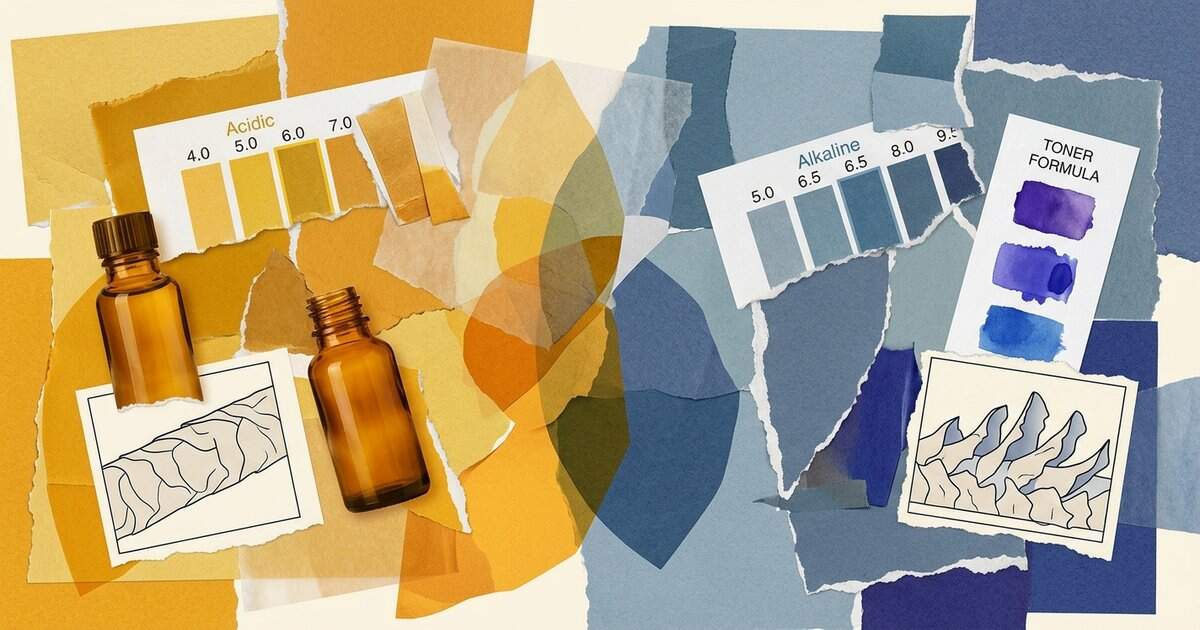
The pH of a toner formulation typically runs between 6.5 and 8.5, which is more alkaline than the hair's natural ideal. This is necessary because the cuticle needs to open slightly for corrective pigment to enter. The tradeoff is that the more alkaline environment keeps the cuticle elevated during processing, which is why toner is applied for a controlled time and then rinsed thoroughly.
Toner's primary purpose is corrective. After a highlight or balayage service, the hair is left with exposed warm pigment that needs neutralizing before the client leaves the salon. Without toner, whatever underlying orange or yellow was exposed by the lightener is exactly what the client walks out with. Toner is not optional after a significant lightening service; it's the step that makes the result match what was planned. For a full explanation of the underlying chemistry, see our piece on why highlights turn brassy and what your colorist should do about it.
What Gloss Actually Is
A gloss is a conditioning treatment that deposits tonal pigment (when tinted) or reflective clarity (when clear) without the corrective function of toner. Its primary purpose is shine, not color correction. The chemistry that produces that shine is important: gloss formulations are acidic, running roughly pH 4.0 to 6.0, which closes and smooths the cuticle rather than opening it. A closed, flat cuticle reflects light more evenly, which is the physical mechanism behind the glassy shine a gloss produces.
Most gloss formulations are applied without developer or with none at all, because the acidic pH doesn't require the cuticle to open for deposit to occur. The acidic environment itself drives the product's effect, which is also why a gloss can be applied to uncolored hair for a shine and conditioning benefit with no risk of color alteration (when using a clear formula).
The hair's natural healthy pH range is 4.5 to 5.5, slightly acidic. A peer-reviewed study published in the International Journal of Trichology (PubMed ID 25210332) examined 123 commercial shampoos and found that products operating at or near this pH range were far better at preserving hair structure and color integrity than alkaline alternatives. After a lightening service, the bleach's alkaline environment pushes the hair above this range and leaves the cuticle in a raised, reactive state. Applying an acidic gloss after lightening does two things: it helps return the hair toward its natural pH, and it physically closes the lifted cuticle. This is why glossing at the end of a color appointment can be both a conditioning benefit and a structural one.
When a gloss is tinted (rather than clear), it deposits a soft layer of color pigment on the surface and just inside the cuticle, refreshing tone without the corrective intensity of toner. Duration is typically four to six weeks for an in-salon treatment.
The pH Difference and Why It Matters for Fragile Hair
The pH distinction between toner and gloss is practical, not just technical, particularly for hair that is already compromised.
After heavy bleaching or color correction, the hair's cuticle is damaged and the hair is structurally vulnerable. Applying a toner (pH 6.5 to 8.5) requires opening the cuticle further to deposit corrective pigment. For hair that's been through multiple lightening sessions, this can be an additional stress on a structure that's already fragile. In these situations, a gloss (pH 4.0 to 6.0) may be the more appropriate finishing step. It deposits tonal enhancement without requiring further cuticle manipulation, and the acidic environment actively works toward closing and smoothing damaged scales.
A colorist who understands this distinction will reach for a gloss finish on extensively processed hair not just for its aesthetic benefit but as a structural choice. This is one situation where gloss and toner are genuinely different interventions with different clinical reasoning behind them.
When They Are the Same
Here's where the real-world picture gets complicated. Some of the most widely used professional color products in LA salons are formulated to function as both toner and gloss simultaneously.
Redken Shades EQ is the clearest example. It is formally classified as an "acidic demi-permanent gloss/toner," a single product that performs both corrective toning and shine enhancement in one application. It carries the acidic pH of a gloss (around 6.5, lower than most traditional toners), deposits corrective pigment via color theory, and closes the cuticle. Depending on how a colorist positions it on the service menu, the same Shades EQ application can be billed as a toner service or a gloss service. The chemistry doesn't change.
Wella's professional gloss formulas similarly perform tonal correction alongside shine enhancement, described by the brand as designed for "precise tonal control" to neutralize brassiness in blonde or balance warm tones in brunettes. When the product is this hybrid, the labels "gloss" and "toner" are genuinely interchangeable, because they're both accurately describing the same service.
Industry sources confirm this openly. The terms cause "active confusion even among professionals." This isn't a consumer education gap; it's an industry nomenclature problem without a central governing body to resolve it. The California Board of Barbering and Cosmetology licenses colorists to perform these services but doesn't define or differentiate gloss from toner for service classification purposes.
The Marketing Dynamic You Should Know About
If both terms sometimes describe the same product and the same chemistry, why does a gloss often cost more than a toner on the same menu?
One answer is positioning. "Gloss" has positive connotations that "toner" doesn't: it's the language of luxury and radiance rather than correction and chemistry. A client who hears "I'm going to apply a toner" understands they're getting a fix for something. A client who hears "I'm going to finish you with a gloss" understands they're getting an upgrade. The service can be identical; the framing is not.
Professional trade sources acknowledge this directly. Colorists can build "tiered pricing structures" by clearly explaining service differences, with toner justified as corrective chemistry and gloss positioned as a premium finishing treatment. Where the chemistry is genuinely different (a corrective demi-permanent toner versus a conditioning clear gloss), that pricing differentiation reflects a real distinction. Where the same product is billed differently based on what word the colorist chose to use, it doesn't.
The third term worth noting briefly is "glaze," which appears alongside gloss and toner on many salon menus. Glaze is largely a marketing-originated term with no standardized chemical definition. In practice it typically describes a lighter-deposit, conditioning-forward treatment similar to a clear or lightly tinted gloss. Its position on the pricing spectrum varies by salon.
When Toner and Gloss Are Both Used in One Appointment
This is a legitimate sequenced approach and not a case of redundancy. After a lightening service, a colorist may apply a corrective demi-permanent toner with developer to neutralize exposed underlying pigment and reach the target shade. Once that's rinsed, they may then apply a finishing acidic gloss to close the cuticle, return the hair toward its natural pH, and maximize shine. The toner does the corrective work; the gloss does the finishing work. These are sequential steps with different mechanisms, not competing choices.
If your colorist is describing this as a two-step service with two line items, that's transparent and accurate. If you're seeing two charges on the invoice and weren't told why, asking for clarification is completely reasonable.
How to Ask the Right Questions at Your Next Appointment
You don't need to arrive with chemistry notes. A few practical questions will tell you what you need to know:
- "When you say gloss, what product are you using and what's it going to do?" This tells you immediately whether you're getting a corrective toner, a shine treatment, or a hybrid formula like Shades EQ that does both.
- "Is this for correcting my undertones, adding shine, or both?" The colorist's answer tells you whether the service is addressing a specific tonal problem or doing finishing work.
- "Is there a difference in cost between a gloss and a toner at your salon, and what does that reflect?" A good colorist will explain this clearly. Reluctance to answer signals that the distinction may not be well-defined.
- "For my hair type and condition, would you recommend a corrective toner with developer or a finishing gloss?" If your colorist can distinguish between these based on your specific hair, they're making a clinical decision rather than a default menu recommendation.
If you're still uncertain how much UV and hard water exposure are affecting your toning needs between visits, see our article on how LA's hard water and sun affect hair color. And if you're comparing LA studios that approach toning and gloss services with this level of transparency, the Hair Color LA ranked comparison of top LA studios is a useful reference point.
How Often Do You Actually Need Either
Duration claims for both services overlap considerably. Toner typically holds four to eight weeks depending on formula, porosity, wash frequency, and water quality. Gloss holds four to six weeks for in-salon treatments. For clients in Los Angeles, both timelines should be shortened: hard water minerals and UV exposure work against tonal hold continuously. LA clients who wash frequently and spend significant time outdoors may find their toner or gloss maintenance needs to run at the shorter end of the range.
Home care extends the result in predictable ways: cooler wash water, sulfate-free shampoo, UV-protective leave-ins, and appropriate toning shampoo (purple for yellow brassiness, blue for orange brassiness) all meaningfully slow tonal fade between appointments. None of them replace an in-salon service, but used consistently, they can push a six-week result closer to eight weeks, which translates to fewer appointments and a better return on what you're spending. For a full breakdown of which at-home ingredients help or harm color, see our guide to shampoo ingredients bad for color-treated hair.