How LA's Entertainment Industry Shapes America's Hair Color
It's the week of the 2025 Oscars. Tracey Cunningham is working out of Meche Salon in Beverly Hills, and she has colored the hair of 17 clients in five days. Emma Stone. Jennifer Lopez. Lindsay Lohan. Amy Poehler. Zoey Deutch. Schwarzkopf Igora Royal and Vibrance, Olaplex protection running through all of it, soft smudge roots and balayage highlights across appointment after appointment. When those clients step onto the red carpet, photographs of their hair will appear in every beauty publication, on every entertainment site, and on social media feeds across the country by the following morning.
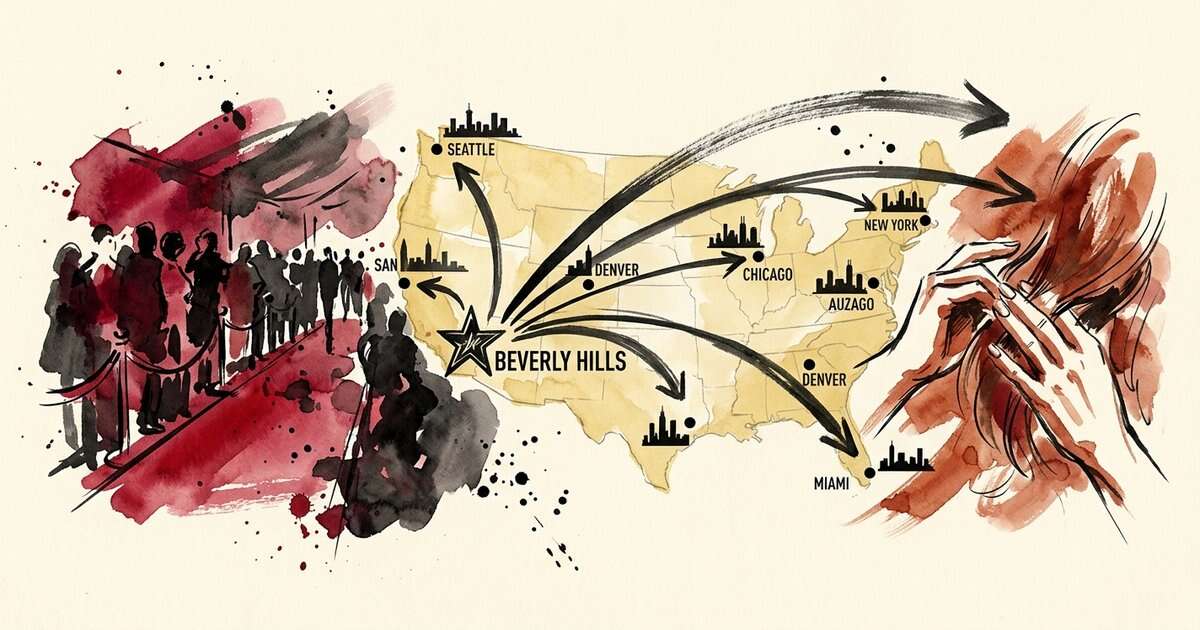
Within two seasons, some version of what Cunningham created that week will be on the request boards of salons in Columbus, Ohio. In Nashville. In Minneapolis. In every city where a client walks in, drops a photo on the consultation table, and says: "I want this."
This is how hair color trends actually travel. And it starts here, in LA.
Why LA and Not New York, Paris, or Milan
Fashion trend authority has historically been distributed across multiple cities. New York sets fashion. Paris sets couture. Milan sets tailoring. But hair color - specifically the kind of color that ends up in American salons two seasons later - has been LA's territory for decades, and the reason is structural, not arbitrary.
The entertainment industry runs year-round in Los Angeles in a way it doesn't anywhere else. Awards season alone spans from January through March, with the Emmys following in the fall. Between those peaks, there are pilots being shot, streaming series in production, editorial shoots for celebrity magazine covers, and an endless cycle of press appearances and red carpets for those projects. All of that requires camera-ready hair. All year. Every year.
That demand creates a concentrated talent pool. New York has celebrity colorists too, but not at the same density. In LA, the working colorist community is described as "tight-knit" - a small group of high-skill practitioners who share clients, follow each other's work closely, and drive innovation by competing for the same appointments. Tracey Cunningham, Chris Appleton, Kari Hill, and Nikki Lee are among the names who have most visibly shaped recent color trends. They all work in LA. That's not coincidence.
In 2018, Henkel formalized what the industry already knew: they moved the professional hair care headquarters for Schwarzkopf Professional, Alterna, Kenra Professional, Sexy Hair, PRAVANA, and #mydentity under one roof in Culver City. Six major professional color brands, consolidated in Los Angeles. Their own press release called it a move to strengthen their "footprint" in the US and enable "cross-company knowledge sharing." What they meant was: the colorists who matter are here, and we need to be near them.
How a Beverly Hills Salon Look Becomes a National Request
The pipeline from LA salon to national booking trend runs through five stages. They explain why the same look tends to show up everywhere within 12 to 18 months of an LA red carpet moment - and why that timeline is getting shorter.
First, demand. The entertainment industry requires color that reads on camera, holds through a production schedule, and looks intentional whether a client is sitting for a magazine cover or walking into a restaurant for a paparazzi shot. That demand pushes colorists to solve specific problems: how do you create highlights that look sun-kissed on camera without reading washed out? How do you build a blonde that can go six weeks without showing an obvious regrowth line, because your client is in the middle of a streaming series and can't come in? The solutions to those problems become techniques.
Second, innovation under pressure. Techniques don't get invented at industry conferences. They get invented when a client is sitting in the chair with a problem that needs solving. Tracey Cunningham's modern ombre - the rooted, luminous highlight style that reshaped color nationally - emerged in 2008 when model Lily Aldridge needed a correction after appearing on an international Vogue cover. Cunningham created what is now called the ombre look to solve that specific problem. It became one of the defining hair color techniques of the following decade.
Third, celebrity amplification. Before social media, a celebrity's new hair color appeared in a magazine spread with a two-month production lag. Since approximately 2015, the timeline has compressed to hours. When Chris Appleton transformed Kim Kardashian from dark brunette to platinum blonde for the 2022 Met Gala - a process that happened in the hours before she stepped onto the carpet - the images were everywhere the same night. Appleton, who counts Jennifer Lopez, Sofia Vergara, Ariana Grande, and Katy Perry among his clients and has been named "Hair Star" by Vogue UK, has an Instagram presence that functions as a real-time trend forecast. What appears there on Monday shows up on client consultation boards by Thursday.
Fourth, industry adoption. Professional color brands - many headquartered in LA or maintaining close relationships with LA colorists - see the demand signal and respond. They develop training programs around new techniques, create product support for them, and roll those educational resources out through their professional networks to salons nationwide. What was an LA colorist's solution becomes a teachable technique available to a colorist anywhere. Schwarzkopf Professional, with its US base in the LA area, is one of the most visible examples of this distribution mechanism in action.
Fifth: consumer pull-through. Clients bring photos to their local salon. The look normalizes. Within 12 to 18 months of a major LA moment, it's on service menus at salons in markets that have zero entertainment industry connection. The person in the chair in Omaha has no idea the technique was invented in Beverly Hills to solve a streaming actress's regrowth problem. She just knows she wants it.
The Historical Arc: California Amplified What France Started
Balayage was invented in France in the 1970s at the Carita salon in Paris. For most of two decades, it stayed largely a European technique. Then, in 1996, a balayage specialist moved to Southern California. Adoption was slow at first - the technique wasn't well-known in the US market. But word spread within the LA community, and by the early 2000s it had arrived in Hollywood.
The visual evidence is in the celebrity hair of that period. Jennifer Aniston's honey-blonde, layered waves from the early 2000s - described by some as "the biggest hairstyle trendsetter of the late '90s and early 2000s" - were LA colorist work, and they put the sun-kissed California blonde aesthetic into the national vocabulary in a way it hadn't been before. Gisele Bundchen's surfer-inspired beachy hair followed a similar pattern: LA colorist, LA editorial context, national reach.
The tipping point came around 2006 to 2008, pushed by two forces. The Victoria's Secret Angels' signature balayaged hair reached enormous mainstream visibility, cementing the technique's association with a specific kind of aspirational beauty. Then the 2008 recession made low-maintenance color a practical choice, not just an aesthetic one. Clients who had been getting single-process color every six weeks discovered that dimensional color grew out more gracefully and required fewer visits. Balayage went from a specialty technique to an industry standard in that window.
None of that happened in New York or Paris or Milan. It happened in Los Angeles, because LA had both the celebrity conduit and the practical, sun-exposed, low-maintenance lifestyle that made the technique make sense for everyday wear. For a look at what LA's sun actually does to color - and why that shapes technique choices - see our guide on protecting color-treated hair through LA summers.
The Colorists Who Set the Agenda
Understanding LA's influence means knowing who is actually doing the work.
Tracey Cunningham is the most cited name in this space for good reason. Co-founder of Meche Salon in Beverly Hills, Schwarzkopf Professional's U.S. Creative Director of Colour, and the colorist whose Oscar-week schedule has become something of a beauty industry event in itself. Her client list spans Emma Stone, Jennifer Lopez, Drew Barrymore, Reese Witherspoon, and dozens of others. The modern ombre is attributed to her. The soft, rooted highlight style that replaced harsh two-tone color in the early 2010s came out of her salon. She has given interviews describing her philosophy as making color look like it grew that way - which is now a near-universal goal in the industry.
Chris Appleton represents the social-media-accelerated version of the same pipeline. His 2022 transformation of Kim Kardashian - dark brunette to platinum blonde in one session, hours before the Met Gala - generated national conversation about what was technically possible. Searches for "platinum blonde" spiked immediately after. Colorists across the country fielded requests for the look within weeks. Appleton has said publicly that he developed his skills working across LA's entertainment industry demands, which required constant problem-solving under real pressure.
The names shift over time, but the pattern holds. LA produces colorists shaped by year-round camera-ready demand. Those colorists solve specific problems under that pressure. The solutions they develop become the techniques everyone is asking for.
Why LA Specifically - and What That Means for a Client Here
Three things make LA the origin point rather than a relay station in this pipeline.
Year-round sun exposure. With more than 280 sunny days a year, LA clients and colorists have always had to solve the UV fade problem. The National Weather Service's Los Angeles forecast office monitors the region's above-average sunshine levels year-round, which are substantially higher than most of the country. Techniques designed to hold up under that much light exposure - dimensional placement, tonal blending, graduated color that reads as sun-kissed rather than faded - were developed here out of necessity. Those techniques translate well nationally because they hold up under any conditions, not just Southern California ones.
Year-round camera culture. Most cities have entertainment industry activity in bursts. LA has it constantly. That constant demand for camera-ready color compresses the innovation cycle: a solution that works gets adopted and refined quickly because there's always another shoot, another red carpet, another reason to need it to work better.
Skin tone diversity. LA's population is genuinely diverse, and the colorist community has had to develop expertise across a wide range of skin tones and natural bases. Techniques that look good on warm olive complexions, deep brown skin, and East Asian hair types alongside the standard reference of fair-skinned, European-textured hair - those techniques travel. They work across the country's diverse client base in a way that techniques developed primarily for one demographic don't.
If you're booking color in LA, you're in the city where these techniques originated - often with colorists who trained under the people who developed them. That's not nothing. The caveat is that "LA-based" is not a quality guarantee. Celebrity colorist proximity produces marketing copy as readily as it produces skill, and plenty of salons here trade on an address rather than a portfolio. Check the work. The zip code is background context, not a credential. To see which studios have earned their standing, the Hair Color LA ranked comparison of top LA studios is a useful reference.
What's Coming Out of LA Salons Right Now
The warm brunette direction - espresso, milk chocolate, multi-tonal caramel - that celebrity colorists like Laurie Heaps are currently executing for high-visibility clients is already working its way through the national trend pipeline. If the pattern holds, it'll be a dominant national request within 18 months. Our piece on the warm brunette revival in LA salons covers the full context of what's driving that shift.
Gray blending, done with balayage-style technique to incorporate natural silver as a design element rather than a problem to cover, is gaining early momentum in the 35-plus LA demographic. That's often where broader national trends begin: in the segment that makes frequent appointments and whose requests are visible to colorists across the industry.
And the soft money piece - warm-toned face-framing panels, more caramel than platinum, more blended than bold - is replacing the high-contrast version that peaked around 2022. What LA colorists are executing now is the refined successor. That will arrive nationally soon enough. It usually does. For a full read on where that face-framing trend stands now, see our piece on the evolution of the money piece trend in LA.