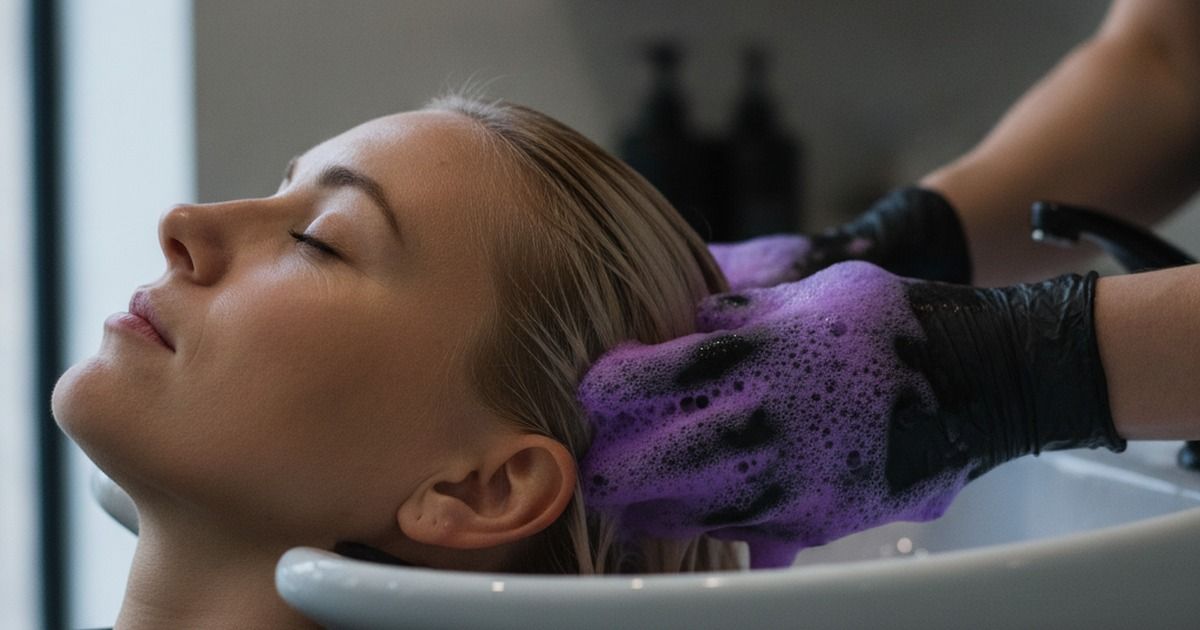

You bought the purple shampoo because a friend, a stylist, or an Instagram ad told you a blonde needs one. Maybe it worked exactly as promised. Maybe your hair came out dull, or slightly gray, or, worse, faintly lilac, and now you're wondering what you did wrong. It's one of the most common complaints about an otherwise simple product, and the confusion almost always traces back to a mechanic nobody explained before you bought the bottle.
So what does purple shampoo do for blonde hair? Less than the marketing suggests: it deposits violet pigment that cancels yellow, and that's the whole trick. It doesn't lighten anything, and it doesn't repair anything. Once you understand the mechanics underneath that one job, every good and bad result you've ever gotten from a bottle of purple shampoo starts to make sense, including the results a stylist ends up correcting.
The Color Wheel Logic Behind Purple Shampoo
Every colorist learns the color wheel before they touch a client's head, because it explains nearly everything about how pigments interact. Colors sitting directly across from each other on the wheel are complementary. Mixed together, they neutralize each other toward a dull, neutral gray-brown rather than combining into a brighter third color.
Violet sits directly opposite yellow. Wella Professionals explains that violet pigment deposited onto yellow-toned hair pulls the color toward a cooler, more neutral shade, which is precisely why toning products built around violet dye are marketed to blondes. Healthline describes the same chemistry from a slightly different angle: purple is really a blend of blue and red wavelengths, and that blend is what allows it to cancel yellow specifically.
Think of it the way a painter mixes a muddy gray from orange and blue paint. Nothing gets erased. One tone simply overwhelms the other until what's left reads as neutral to the eye. Purple shampoo works the same way on hair, except the "paint" is a small dose of violet dye molecule suspended in a mild cleansing base.
The "canvas" is your hair's cuticle, the outermost layer of the hair shaft that opens slightly with heat and water and closes back down as it dries. The violet pigment sits in and on that cuticle layer. It never travels past it, which is exactly why it can neutralize a tone without touching the internal structure that actual lightening or coloring changes. That boundary is also why the effect fades away with washing instead of growing out the way permanent color does: the pigment sits on the surface, not inside the strand.
Why It Works So Well on Some Blondes
If you have pale yellow, warm-blonde, or cool-toned hair, whether that's your natural shade or the result of lightening and highlighting at a salon, purple shampoo tends to look close to magical. The yellow it's designed to fight is exactly the tone sitting in your hair. A small, controlled deposit of violet does what the color wheel predicts: it neutralizes the warmth and leaves behind a cleaner, brighter blonde. In that case the product genuinely lives up to what the label promises, because the starting tone is already close to the pigment's ideal target.
This is the audience the product was built for, and it's also why so many bottles get sold on word of mouth from someone whose hair happened to be the ideal starting point. A client who just had highlights refreshed at a Los Angeles salon, with a light, even base and minimal yellow to begin with, is about as close to that ideal as it gets.
The keyword there is starting point. Level (how light or dark a shade is, measured on a numbered scale from black to lightest blonde) and undertone (the warm or cool cast underneath that level) both determine how much violet a head of hair actually needs. A light, cool-leaning blonde needs very little. Everyone downstream of that ideal case is working with a less forgiving margin, and that margin is where most of the bad results come from.
Where Purple Shampoo Goes Dull, Ashy, or Lilac
Very light, heavily lightened, or highly porous hair grabs violet dye faster and holds onto more of it. Porosity is how easily the hair shaft absorbs and holds moisture and pigment, and it's usually elevated by repeated bleaching, which roughens and opens the cuticle. Give that porous hair the standard leave-in time meant for a less porous head, and it can tip past neutral into a visible violet cast.
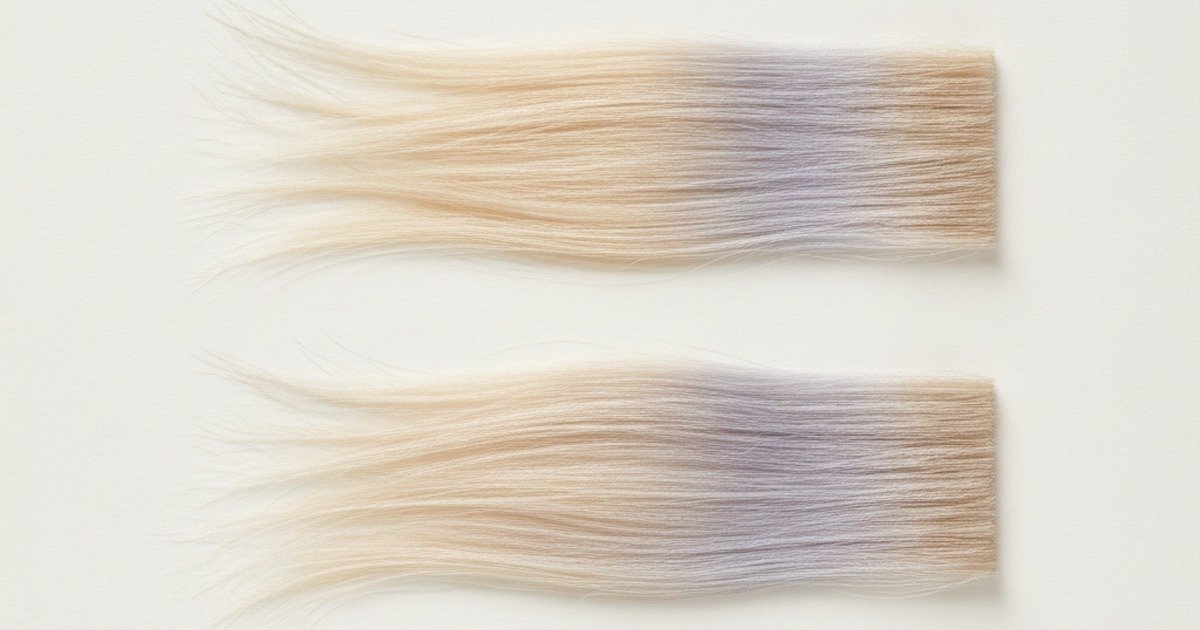
Style House Salon puts this plainly: overusing purple shampoo "can dull down your blonde and even cause the shade to shift to a grayish/violet color."
Leave-in time is the dial that decides which outcome you get, and it's worth naming the actual range. Wella specifies massaging the product into wet hair and letting it work for three to five minutes. Healthline puts the range across brands closer to two to five minutes (both sourced above).
Longer contact time deposits more pigment. That single variable, stacked on top of how porous your hair already is, is most of the explanation for why the same bottle brightens your friend's hair and turns yours faintly gray or violet-tinted. Same chemistry, different canvas. Two people can start with hair that looks nearly identical after a salon visit and still end up with completely different results, simply because one of them washed more often or left the product on longer.
Adam Reed, editorial ambassador for L'Oréal Professionnel UK, has seen this pattern from the chair side too. Overuse "can sometimes over-eliminate tones and make the blonde appear visually darker" than it started, which is the opposite of what most people are chasing when they reach for the bottle in the first place, according to Get the Gloss.
Why It Does Nothing for Orange or Brassy Brown
Here's where a lot of people waste money on the wrong bottle. If your brassiness reads orange rather than yellow, whether that's an orange cast on highlighted brown hair or warmth showing through on a bronde base, purple shampoo has nothing to neutralize. Violet only cancels yellow. No amount of extra leave-in time or repeat washing changes that, because the chemistry simply isn't built to address orange or red at all.
Orange sits opposite blue on the color wheel, which is why blue-toned shampoo is the correct tool for orange and red-leaning brassiness. Davines states this directly: purple shampoo is "not effective for orange or red tones," which explains a large share of the "it didn't do anything for me" complaints that show up online.
Telling the two apart isn't always obvious in bathroom lighting. Yellow brassiness tends to look like a warm haze across the whole head, evenly distributed. Orange brassiness tends to concentrate at the mid-lengths and ends, where more of the hair's natural warm pigment has been exposed by lightening. Checking your hair in daylight, not under warm bathroom bulbs, usually settles which one you're actually looking at.
This is also worth separating from ingredient chemistry, which is a different topic entirely. What actually strips or fades color between salon visits is covered in depth in our piece on which shampoo ingredients fade color-treated hair. Purple and blue toning shampoos deposit pigment rather than removing it, and the color wheel decides whether that deposit helps or does nothing at all. Both problems can show up on the same head at once, which is part of why the actual cause of dull, faded color so often gets misdiagnosed at home.
The same logic explains why highlights turn brassy in the first place. Warm pigment in the hair's natural base gets exposed as lighter tones fade, and whether purple shampoo can address that depends entirely on whether the resulting brassiness reads yellow or orange.
How Often to Use It, and How Long to Leave It In
Frequency follows what your hair is actually doing, and treating it as a fixed calendar is how most overuse happens. Wella recommends roughly once a week to keep brassiness in check, with visible yellow or orange creeping back in as the real cue to reapply rather than a set day on the calendar. Healthline notes that most formulas are built for once or twice weekly use rather than daily rotation, though strength varies by brand (both sourced above). That cue-based approach protects against the overuse pattern described earlier, since it ties application to what your hair is actually showing rather than to habit.
Style House Salon frames the safer habit even more conservatively: using it "every other time you wash your hair or even every two times," rather than every single wash (sourced above).
Read your hair, not a schedule. If the blonde still looks clean and bright by your next wash, you didn't need it that day. If yellow is creeping back in after one wash, once a week is probably your number. The leave-in time matters just as much as frequency: two to five minutes is the working range across the brands referenced above, and stretching that time on porous or heavily lightened hair is exactly how brightening tips over into the dull or lilac results described earlier.
It's also worth building in a pause around salon visits. Jimmy Green, Education Manager for Pureology and Redken, advises stopping purple shampoo about a week before a color appointment: "Stop using purple shampoo a week or so before you have your colour done. This way your stylist will get a better impression of the canvas they are working on" (Get the Gloss, sourced above).
Style House Salon's guidance runs the other way too, after a visit: a fresh demi-permanent toner, a temporary color that adjusts tone without lifting the hair's natural pigment, needs a few days and a couple of washes to settle fully into the cuticle. Using purple shampoo too soon can pull that toner's pigment back out before it has anchored, which is a large part of the difference between a toner that holds and one that fades early.
What a Colorist Sees When You've Overdone It
This is the part most product pages skip entirely, and it's the part that actually costs you money. When a client sits down for a color appointment with months of heavy purple shampoo use behind them, a colorist isn't reading their natural base tone anymore. They're reading a base tone plus a layer of deposited violet pigment, and the two can look nothing alike. That distortion is exactly why a colorist will often ask, before anything else, what's been used on the hair recently.
Anneliese Hesse, a colorist with Humankind Hair Training Academy and Tribe Salons, has described exactly what that buildup does. It "stains the hair and can make it look dull/darker," and correcting it sometimes requires bleaching the buildup back out before any new color work can start (Get the Gloss, sourced above). Correcting that buildup is its own appointment step, and it usually costs extra.
Paul Edmonds, a Shu Uemura ambassador, puts the fix in the client's hands rather than the colorist's. Tell your colorist exactly what you've been using and how often, "so they can correctly assess what to use on your hair" (Get the Gloss, sourced above).
That one sentence before your appointment, naming the product, the frequency, and roughly when you last used it, can be the difference between a straightforward toner refresh and a color correction appointment that runs longer and costs more than it needed to.
There's a second, quieter cost that shows up between appointments rather than in the chair. Los Angeles tap water runs hard, and combined with the region's sun exposure, that hardness already pulls warmth and tone out of color-treated hair faster than most people expect, a dynamic covered in more detail in our piece on hard water and LA sun fading hair color. None of that is purple shampoo's fault, but it does mean the margin for overuse is thinner here than it would be somewhere with softer water and less direct sun.
Layer heavy-handed purple shampoo use on top of water and sun already working against your color, and you're fighting your own routine from two directions at once. The fix is straightforward: let what you see in the mirror set the schedule, and say so out loud before your colorist starts mixing formula.